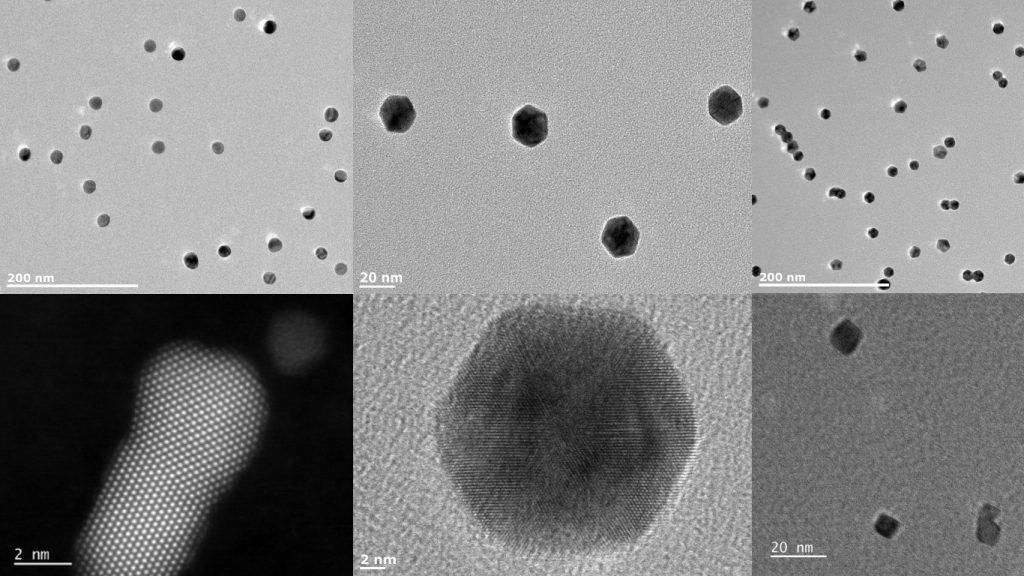
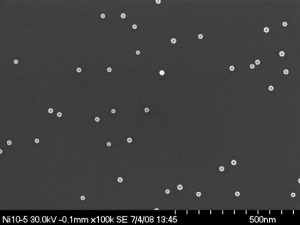
Magnetic nanoparticles are a major class of nanomaterials that offer unique advantages in MRI diagnostics. This blog post covers the fundamentals of magnetic nanoparticles and sees how they’re enabling more accurate medical diagnoses.
What are magnetic nanoparticles?
Many people are familiar with the idea that materials have certain properties that are independent of size, such as stiffness, thermal conductivity and electrical resistivity. Nanoparticles put this idea to the test.One of the defining characteristics of nanoparticles (pieces of material between around 1 and 100 nanometers in diameter) is that being very small makes them behave strangely. The properties of a copper nanoparticle, for example, are remarkably different from the properties of bulk copper that we may be accustomed to in our day-to-day “macroscale” world – and these properties are often very strongly dependent on a nanoparticle’s size.Many of these “strange” properties are a result of the fact that very small particles have very high surface-area-to-volume ratios, which means that surface effects tend to dominate over bulk effects. For example, nanoparticles tend to have very high solvent affinities that enable them to form suspensions in water, and they also tend to exhibit radically different mechanical properties from bulk solids.Other interesting properties arise from the confinement of subatomic particles such as electrons, protons and photons with nanoparticles: these include surface plasmon resonance in some metals and quantized electronic energy levels in semiconductor nanoparticles below 10 nm in diameter.Perhaps unsurprisingly, magnetic nanoparticles (those made from magnetic materials) exhibit their own unique behavior, particularly a phenomenon known as superparamagnetism. This particular quirk of magnetism means that magnetic nanoparticles can perform an invaluable role as contrast agents in MRI applications. Magnetic nanoparticles also have a range of other potential applications in biomedicine, catalysis and sensing.Properties of Magnetic NanoparticlesBulk ferromagnetic materials such as iron are typically divided into magnetic “domains” – groupings of atoms that share the same magnetic alignment.1 These domains are magnetically susceptible, meaning an external magnetic field can “flip” the orientation of domains and cause them to line up with each other. This magnetization will persist until the material is heated to its Curie temperature – usually hundreds of degrees centigrade (770 C in iron).Producing magnetic nanoparticles from ferromagnetic materials causes a few changes. Firstly, because magnetic nanoparticles are so small, a single magnetic nanoparticle will constitute a single magnetic domain – this means that there can be no magnetic ordering within a sample of magnetic nanoparticles. Secondly, decreasing the volume of a magnetic nanoparticle effectively decreases its Curie temperature.2,3 In sufficiently small magnetic nanoparticles, thermal energy at room temperature is sufficient to flip their magnetization spontaneously.The results in magnetic nanoparticles can exhibit superparamagnetism. The nanoparticles exhibit high susceptibility to external magnetic fields, but magnetic nanoparticles do not retain this magnetization once the field is removed, unlike macroscale magnets.
Using Magnetic Nanoparticles in MRI
MRI (magnetic resonance imaging) is a medical imaging technique that magnetizes atomic nuclei in the body and measuring the “relaxation time” required for them to reorient themselvesMagnetic nanoparticles, especially ones made from iron oxide, make excellent MRI contrast agents.4,5 This is thanks not only to their unique magnetic properties but also to the fact that they offer excellent biocompatibility and biodegradability and can be tailored to specific types of tissue within the body. Functionalizing magnetic nanoparticles with ligands such as sugars, antibodies or short peptide chains enables them to preferentially bind to certain tissues or structures within the body. Bound magnetic nanoparticles can be easily detected via MRI, enabling these structures to be imaged in much greater detail than would otherwise be possible.Iron Oxide NanoparticlesAs a result, magnetic nanoparticles are currently undergoing development and application for improved diagnosis of a wide range of diseases, including cancer, cardiovascular disease and neurological disease.
Nanoparticles from Nikalyte
Nikalyte deposition equipment can generate high-quality nanoparticles from a wide range of materials, including iron, iron oxide, nickel and nickel oxide. We also offer a consultancy service, enabling our customers to take advantage of our 20+ years of expertise in nanoparticle technology. Get in touch with us today to find out more about our services and solutions.Nickel NanoparticlesReferences and Further Reading
Mcnerny, K., Kim, Y., Laughlin, D. & McHenry, M. Chemical synthesis of monodisperse γ-Fe–Ni magnetic nanoparticles with tunable Curie temperatures for self-regulated hyperthermia. Journal of Applied Physics107, 09A312-09A312 (2010).
Colossal Reduction in Curie Temperature Due to Finite-Size Effects in CoFe2O4 Nanoparticles | Chemistry of Materials. https://pubs.acs.org/doi/10.1021/cm301927z.
Avasthi, A., Caro, C., Pozo-Torres, E., Leal, M. P. & García-Martín, M. L. Magnetic Nanoparticles as MRI Contrast Agents. Top Curr Chem (Z)378, 40 (2020).
Rümenapp, C., Gleich, B. & Haase, A. Magnetic Nanoparticles in Magnetic Resonance Imaging and Diagnostics. Pharmaceutical research29, 1165–79 (2012).
We use cookies on our website to give you the most relevant experience by remembering your preferences, repeat visits and also for personalised advertising of our goods and services. By clicking “Accept All”, you consent to the use of ALL the cookies. However, you may visit "Cookie Settings" to provide controlled consent. View our Privacy and Cookie Policy for more information.
This website uses cookies to improve your experience while you navigate through the website. Out of these, the cookies that are categorized as necessary are stored on your browser as they are essential for the working of basic functionalities of the website. We also use third-party cookies that help us analyze and understand how you use this website. These cookies will be stored in your browser only with your consent. You also have the option to opt-out of these cookies. But opting out of some of these cookies may affect your browsing experience.
Necessary cookies are absolutely essential for the website to function properly. These cookies ensure basic functionalities and security features of the website, anonymously.
Cookie
Duration
Description
cookielawinfo-checkbox-analytics
11 months
This cookie is set by GDPR Cookie Consent plugin. The cookie is used to store the user consent for the cookies in the category "Analytics".
cookielawinfo-checkbox-functional
11 months
The cookie is set by GDPR cookie consent to record the user consent for the cookies in the category "Functional".
cookielawinfo-checkbox-necessary
11 months
This cookie is set by GDPR Cookie Consent plugin. The cookies is used to store the user consent for the cookies in the category "Necessary".
cookielawinfo-checkbox-others
11 months
This cookie is set by GDPR Cookie Consent plugin. The cookie is used to store the user consent for the cookies in the category "Other.
cookielawinfo-checkbox-performance
11 months
This cookie is set by GDPR Cookie Consent plugin. The cookie is used to store the user consent for the cookies in the category "Performance".
viewed_cookie_policy
11 months
The cookie is set by the GDPR Cookie Consent plugin and is used to store whether or not user has consented to the use of cookies. It does not store any personal data.
Functional cookies help to perform certain functionalities like sharing the content of the website on social media platforms, collect feedbacks, and other third-party features.
Performance cookies are used to understand and analyze the key performance indexes of the website which helps in delivering a better user experience for the visitors.
Analytical cookies are used to understand how visitors interact with the website. These cookies help provide information on metrics the number of visitors, bounce rate, traffic source, etc.
Advertisement cookies are used to provide visitors with relevant ads and marketing campaigns. These cookies track visitors across websites and collect information to provide customized ads.