
Alloy Nanoparticle UHV Deposition Source: NL-UHV Series
The NL-UHV Series nanoparticle (cluster) sources generate pure and alloy nanoparticles in ultra-high vacuum to create functional coatings. They offer precise control over nanoparticle size, composition, and structure. Size filtering is achieved using an inline mass filter.
NL- UHV Nanoparticle Deposition Source uses the Terminated Gas Condensation Technique, that generates nanoparticles by rapidly cooling and condensing gas-phase metal or alloy vapors into nanoparticles within an ultra-high vacuum (UHV) environment. In this metal vapors is sputtered from the target surface by an argon plasma and then travels through the aggregation zone where it cools to form nanoparticles. This technique allows for precise control over the nanoparticle’s properties, such as size, composition, and structure, making it ideal for producing high-quality functional coatings, and other advanced materials for research and industrial applications.
Available in a single 1″ source (NL-D1), 2″ source (NL-D2), or triple 1″ source (NL-D3). The NL-UHV can be integrated into an existing PVD systems or our custom NL-CUBE and NEXUS system.
Key Features
- Deposit pure and alloy, hydrocarbon-free, non-agglomerated nanoparticles.
- Achieve sub-monolayer or high-porosity 3-D nanocoating.
- The NL-D3 facilitates the deposition of up to three materials, either individually or as alloys, using two or three materials at the same time.
- All sources are compatible with both DC and Pulsed DC power supplies.
- Control the properties of the nanoparticle coatings by adjusting various process parameters, such as gas flow, gas type, magnetron power, and aggregation length (Lg), or by altering the size of the aggregation zone aperture.
Control of Nanoparticle size using NL- QMS
Quadrupole Mass Spectrometer
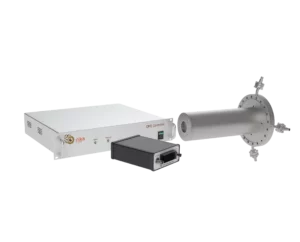
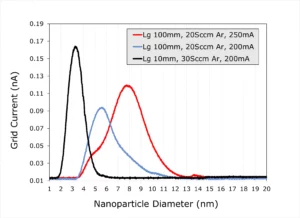
The NL-QMS mass filter enables real-time scanning or filtering of deposited nanoparticles by mass or diameter, facilitating the optimization of growth conditions.
Highlights
⇒ Adjust the nanoparticle size distribution within the range of 1 – 20 nm.
⇒ Modify the nanocoating layer density from a sub-monolayer to 3D nanoporous coverage, facilitating coatings that range from loosely bound to tightly adherent.
⇒ Manage the nanoparticle shape and structure, transitioning from crystalline to amorphous forms.
⇒ Conduct mass spectrum analysis of nanoparticles in flight, covering a range from 100 – 10 6 amu.
⇒ Implement nanoparticle size filtering with a mass resolution accuracy of +/-2%.
NL- QMS Control Software
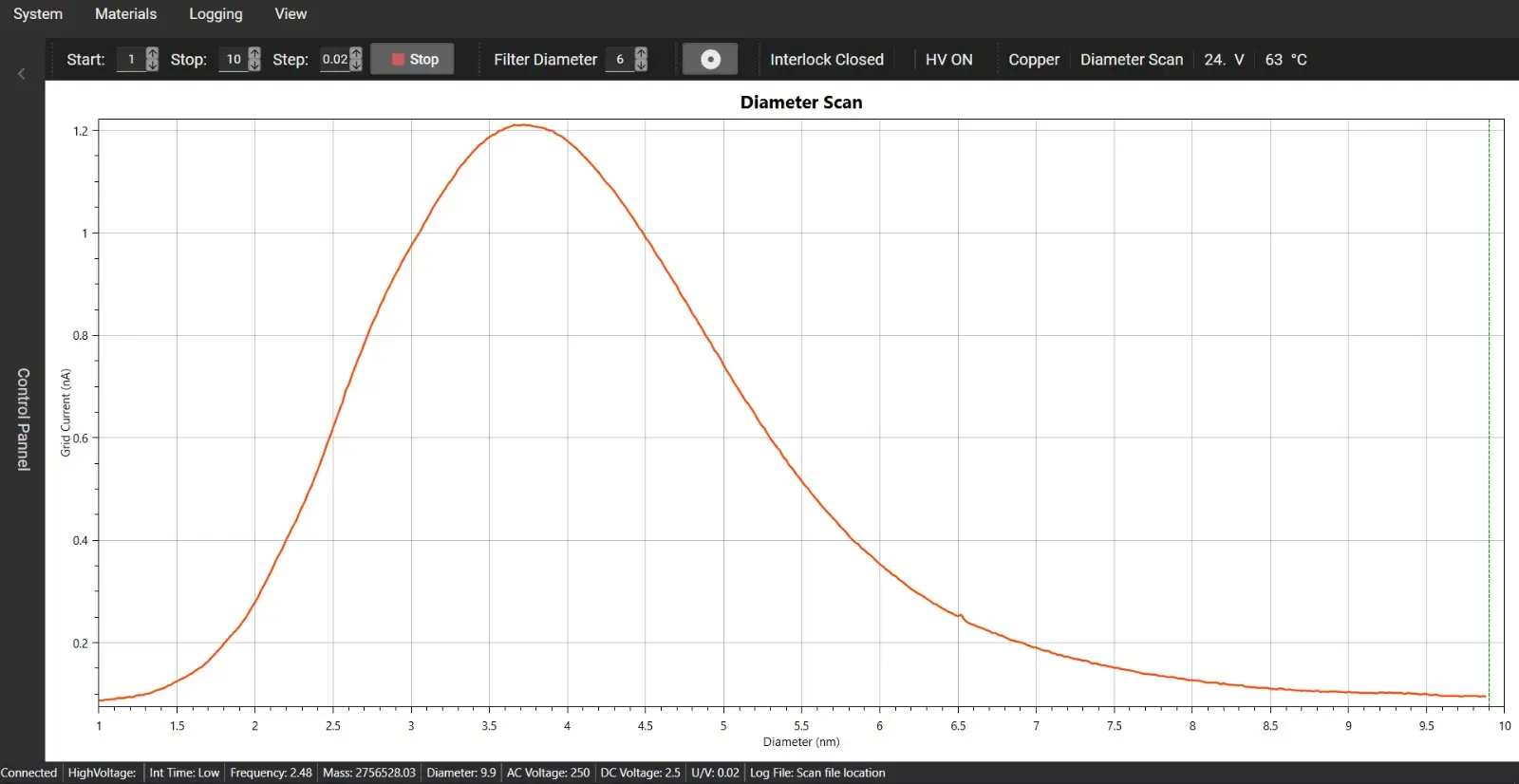
The NL-QMS is operated through a simple and user-friendly Windows™ software interface.
Highlights
Data logging for mass spectra
Preloaded mass calibration data for standard materials
Input parameters for novel materials or alloys
Complete control over QMS operations and scanning configurations
Specifications
| Utility | NL-DXX | NL-QMS |
| Mounting Flange | DN160CF | DN160CF |
| Power | 630V DC or Pulsed DC | 100-250Vac 4Amp fuse |
| Gas | Argon/Helium 2-100Sccm | |
| Cooling Jacket | Water or LN2 Flow rate 2l/min (0.52 US GPM) | |
| Pumping | 120L/m (4.2 CFM) Backing pump 300L/m (10.6 CFM) Turbo pump | |
| Aperture plates | 2mm, 3mm, 4mm and 5mm aperture plates supplied as standard |
NL-DXX Options
| Source Options | NL-D1 | NL-D2 | NL-D3 |
| Source Output | 75W dc | 100W dc | 3 x 75W dc |
| Sputter Target | 1 x 1″ | 1 x 2″ | 3 x 1″ |
| Target Thickness | 0.5 – 3mm | ||
Publications
Mouti, N., Kostoglou, N., Obenaus-Emler, R., & Mitterer, C. https://doi.org/10.1116/6.0004328
Çiçek, A., Kratzer, M., Teichert, C., & Mitterer, C. https://doi.org/10.3762/bxiv.2025.46.v1
Florian Knabl, Christine Bandl, Thomas Griesser, Christian Mitterer. DOI: 10.1116/6.0003283
Florian Knabl. DOI: 10.34901/mul.pub.2024.129
Elizabeth S. Jones, Dr. Charalampos Drivas, Dr. Joshua S. Gibson, Dr. Jack E. N. Swallow, Dr. Leanne A. H. Jones, Thomas D. J. Bricknell, Dr. Matthijs A. van Spronsen, Prof. Georg Held, Dr. Mark A. Isaacs, Dr. Christopher M. A. Parlett, Prof. Robert S. Weatherup. DOI: 10.1002/cctc.202400239
Florian Knabl, Dominik Gutnik, Prathamesh Patil, Christine Bandl, Tijmen Vermeij, Christian M. Pichler, Barbara Putz, Christian Mitterer. DOI:10.1016/j.vacuum.2024.113724
Edwards, P.J., Khojasteh, M., Halder, A. et al. DOI: 10.1007/s10948-021-06062-y
Cong, P., Gibson, J., Jones, E., Swallow, J., Liu, L., Jones, L., et al. DOI: 10.26434/chemrxiv-2025-0cgp0
Frequently Asked Questions
The NL-UHV is a UHV-compatible nanoparticle (cluster) deposition source that uses the Terminated Gas Condensation technique. Metal or alloy vapour is sputtered from a target by an argon plasma, then cooled and condensed into nanoparticles within an ultra-high vacuum aggregation zone. The result is pure, hydrocarbon-free, non-agglomerated nanoparticles with precise control over size, composition, and structure.
Yes. The NL-D3 variant houses three 1″ sputter targets, allowing deposition of up to three materials either individually or simultaneously as binary or ternary alloys. This makes it well suited for high-entropy alloy (HEA) nanoparticle research and multi-component functional coatings.
Nanoparticle size is controlled through process parameters including gas flow rate, gas type, magnetron power, aggregation length, and aggregation zone aperture size (available as 2, 3, 4, and 5 mm plates). The majority of nanoparticles are singly and negatively charged. So, for tighter size selection, the optional NL-QMS inline quadrupole mass spectrometer filters nanoparticles by mass or diameter in real time, with a size range of 1–20 nm and mass resolution of ±2%.
The NL-UHV is used across a range of research and industrial applications including SERS substrate fabrication, electrocatalysis (including OER catalysts for green hydrogen production), Fischer-Tropsch synthesis, superconductivity research, and in situ XPS studies. Its ability to produce size-selected, composition-controlled nanoparticle coatings makes it a versatile tool for surface science and advanced materials research.
The NL-UHV can produce coatings ranging from sub-monolayer nanoparticle films to high-porosity 3D nanoporous structures. As mentioned above the particle are negatively charged. This means that the nanoparticle film density can be tuned by changing the kinetic energy of the nanoparticles by applying a positive voltage to the product/substrate (typically 0V-5000V).This allows researchers control over whether nanoparticles are loosely distributed or form a tightly adherent porous network.
Yes. The NL-UHV series mounts on a DN160CF flange and can be integrated into existing PVD systems or incorporated into Nikalyte’s NL-CUBE compact PVD platform and the custom-built NEXUS system. This allows the nanoparticle source to be combined with thin-film deposition techniques such as sputtering or e-beam evaporation within a single vacuum system.