
Industry: Biomedical / Orthopaedic and Dental Implants
Challenge:
Titanium alloys such as Ti6Al4V are the material of choice for orthopaedic and dental implants, valued for their mechanical strength, corrosion resistance, and biocompatibility. However, their bioinert nature means they cannot chemically bond with surrounding bone tissue, and implant-associated bacterial infections remain a leading cause of revision surgery. Studies report early dental implant failure linked to postoperative infection at rates exceeding 20%, with a significant proportion of patients requiring surgical retreatment after antibiotic failure.
A research team led by Dr Sitki Aktas (Giresun University) and Prof Andrew Pratt (University of York) set out to address this dual challenge: how to engineer a titanium implant surface that simultaneously resists bacterial colonisation and supports bone cell integration.
Their approach combined microarc oxidation (MAO) a plasma electrolytic technique that produces a highly porous, bioactive TiO₂ layer on Ti6Al4V with the controlled deposition of silver-based nanoparticles (NPs) to confer antibacterial function without compromising osteoblast viability.
The core research question was whether gas-phase deposition could deliver Ag/AgO/Ag₂O NPs at precise, controllable concentrations onto complex porous MAO surfaces preserving surface morphology, achieving homogeneous distribution, and producing a multifunctional coating that works against both E. coli and S. aureus.
Solution:
The team used Nikalyte’s NL50 benchtop systemsystem to deposit Ag-based NPs directly onto MAO-treated Ti6Al4V substrates under high-vacuum conditions.
The NL50 operates by introducing a controlled argon flow 40 sccm in this study into a bullet-shaped aggregation chamber housing a magnetron sputter head. Argon sputters a silver target, generating a supersaturated vapour that nucleates and aggregates into discrete NPs. Differential pumping between the aggregation chamber and the sample chamber creates a jet-like pressure gradient, forming a directed NP beam that deposits gently onto the substrate surface. Crucially, NP size is governed by Ar flow rate and plasma power (50 W), enabling reproducible, tuneable deposition without liquid-phase chemistry or post-processing.
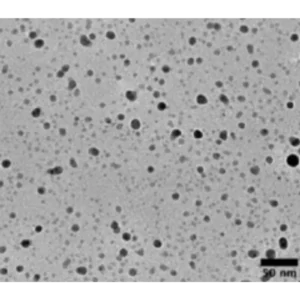
Image Description: TEM micrograph of Ag/AgO/Ag₂O nanoparticles deposited using the Nikalyte NL50 gas aggregation cluster source. Most probable particle diameter 8.7 ± 0.1 nm. Scale bar: 50 nm. Credit: Aktas et al., ACS Omega 2026, 11, 5526–5537. CC BY 4.0.
Three deposition densities were produced by varying deposition time: 4, 8, and 12 minutes (MAO-Ag1, MAO-Ag2, and MAO-Ag3 respectively), yielding Ag surface concentrations of 0.5, 1.1, and 1.5 wt% as confirmed by EDX analysis.
TEM characterisation of NPs deposited under identical conditions onto a reference grid revealed a log-normal size distribution with a most probable diameter of 8.7 ± 0.1 nm. Smaller particles oxidised in air to AgO and Ag₂O, while larger particles (~10 nm) retained metallic Ag producing a mixed Ag/AgO/Ag₂O composite confirmed by XPS. This multi-phase composition is significant: the different oxidation states provide a multi-stage Ag⁺ ion release mechanism, sustaining antibacterial efficacy over time rather than delivering a single burst.
SEM imaging confirmed that the rough, porous MAO morphology beneficial for osseointegration was fully preserved across all three deposition densities, with NPs distributed homogeneously across both flat regions and the interior surfaces of pores.
Results:
Antibacterial inhibition increased systematically with NP loading across both bacterial species. At the highest deposition density (MAO-Ag3, 12 minutes), the coating achieved approximately 76.7% inhibition of S. aureus and 73.0% inhibition of E. coli, compared to just 28.2% and 20.0% respectively for the MAO surface alone. The antibacterial effect stemmed from three synergistic mechanisms:
- Ag⁺ ion release disrupting bacterial membrane integrity and inhibiting cellular function
- Reactive oxygen species generation from AgO and Ag₂O phases
- Reduced bacterial adhesion driven by altered surface wettability
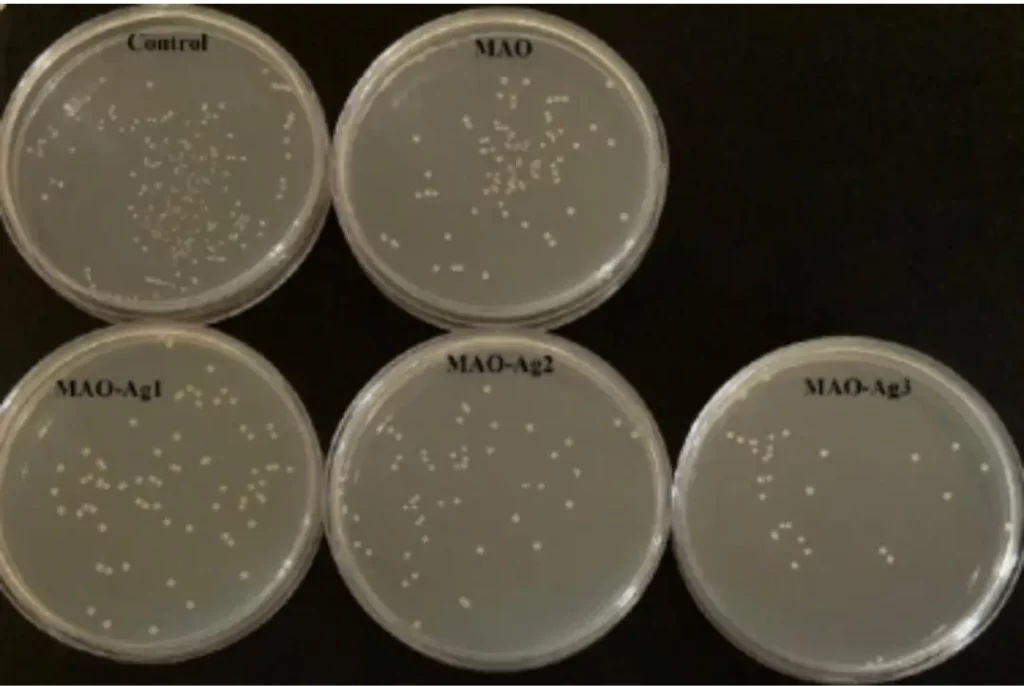
Image Description: Bacterial colony counts (E. coli) across control, MAO, and Ag/AgO/Ag₂O NP-coated MAO surfaces (MAO-Ag1, MAO-Ag2, MAO-Ag3). Colony reduction increases with NP deposition density. Credit: Aktas et al., ACS Omega 2026, 11, 5526–5537. CC BY 4.0.
Osteoblast cytocompatibility was evaluated using hFOB 1.19 human osteoblast cells over 72 hours. WST-8 metabolic activity assays showed no statistically significant reduction in cell viability on any Ag-coated surface, and SEM imaging confirmed healthy attachment and spreading, with filopodia and lamellipodia clearly visible across all surfaces.
Wettability shifted from hydrophobic (contact angle 94.1 ± 0.3° on MAO alone) to hydrophilic following NP deposition a change associated with improved protein adsorption and cell adhesion in implant environments.
Conclusion:
This study demonstrated that Nikalyte’s NL50 gas aggregation cluster source can deliver precisely controlled, homogeneously distributed Ag/AgO/Ag₂O nanoparticle coatings onto topographically complex MAO-treated titanium surfaces without disrupting the porous architecture that drives osseointegration.
The gas-phase approach offers key advantages over wet-chemistry deposition routes: no solvents or reducing agents, precise size and concentration control, high-vacuum cleanliness compatible with sensitive biomedical substrates, and the ability to coat pore interiors as well as flat surface regions.
The resulting multifunctional coating delivered up to 76.7% inhibition of S. aureus and 73.0% inhibition of E. coli at the highest deposition density, while fully preserving osteoblast viability and proliferation at 72 hours. The multi-phase Ag/AgO/Ag₂O composition an inherent outcome of size-dependent oxidation in gas-phase NP synthesis provides a sustained ion release profile that wet-chemistry routes struggle to replicate without additional functionalisation steps.
The authors note that further optimisation of NP size distribution and deposition density, together with in vivo validation, represents a clear pathway toward clinical translation of this coating strategy for orthopaedic and dental implants.
Note: Full details of the project and results can be found in the publication here
Interested in applying nanoparticle antibacterial coatings to your biomedical research?
Contact us today to discover how Nikalyte’s NL50 can support your work.